
Heating and Cooling Guide for Your Growing Dome
A Growing Dome is its own climate system. The shell, the pond, the vents, the shade cloth, the fans, and the undersoil ducting work together to regulate temperature. Active heating and cooling equipment is a helper for specific demanding cases, not the primary system. For most growers in most climates, supplemental heating or cooling in a Growing Dome isn’t needed.
Page Reviewed by: Growing Spaces R&D Last Updated: 5/6/2026

Quick answer
In typical U.S. climates, the dome supports year-round growing passively for most gardening goals.
- Start with the Greenhouse Equipment Sizing Calculator for your ZIP code, dome size, and what you want to plant.
- The result will tell you whether you need anything beyond the standard kit, and what (if anything) to add.
- This guide explains what the calculator's recommendation means, when active equipment is worth considering, and how to talk to your HVAC contractor.
This guide is a planning tool. It is not a final HVAC design, quote, warranty, code determination, or guarantee of interior temperature, crop yield, energy use, or equipment performance.
Your Growing Dome IS a climate system
A Growing Dome isn't a greenhouse with HVAC equipment bolted on. The standard kit on every dome is the climate system:
- 16 mm five-wall polycarbonate glazing with an insulated north wall
- An above-ground pond, sized to the dome, that absorbs daytime heat and releases it overnight
- 50% aluminet shade cloth, deployed seasonally
- Top and lower heat activated vents on 26 ft and smaller domes
- Fans on all domes, with more active ventilation fan capacity standard on the 33’ and 42’
- Undersoil air ducting that gently recirculates pond-moderated air through the planting beds
These aren't accessories. They're integrated by design and by 37 years of operating experience. Most growers never need anything else.
When the calculator recommends a heat pump, evaporative cooler, dehumidifier, or supplemental heater, that equipment is meant to bridge the gap between your growing goals and what the dome can support passively. It's not the primary climate system; the dome is.


When passive is enough
For growers in most U.S. climates, a Growing Dome operates without active heating or cooling equipment for most of the year, and often year-round.
Growing Spaces has manufactured Growing Domes since 1989. Our own demonstration domes operate in the Colorado mountains. We run them across spring, summer, and fall actively, with cool-season production through winter. The recommendations in the calculator and the patterns in this guide reflect that operating experience.
The methodology paper describes four operating cases (section 10.2). Three of them are passive-first or supplemental-only by default:
| Operating case | What you grow | Climate equipment typically needed |
|---|---|---|
| Case 1: Spring through fall growing | Tomatoes, peppers, squash, greens, herbs in their natural seasons. Dome rests in winter. | Passive in most climates. Cold-continental zones may want a small heater for freeze protection of structure and pond. |
| Case 2: Year-round, cool-season crops in winter | Cool-season crops (greens, brassicas, root vegetables) through winter. Warm-season crops in their season. | Passive in mild climates. Cold zones use a small supplemental heater for cold cloudy nights. |
| Case 3: Year-round, warm-season plants in winter | Warm-season plants (tomatoes, peppers, citrus) maintained through winter. Plants survive but don't necessarily produce in deep winter. | Cold zones use a small supplemental heater to hold above freezing on the coldest nights. |
| Case 4: Year-round fruiting plants and strict temperature control | Active January tomato or pepper production at 50°F maintain with no drift. | Heat pump plus supplemental heater (Strict mode in the calculator). |
Climate Patterns
The dome's role is different in different climates. Matching what you grow when to your natural climate rhythm is often a better path than buying equipment to override it. A few patterns by zone:
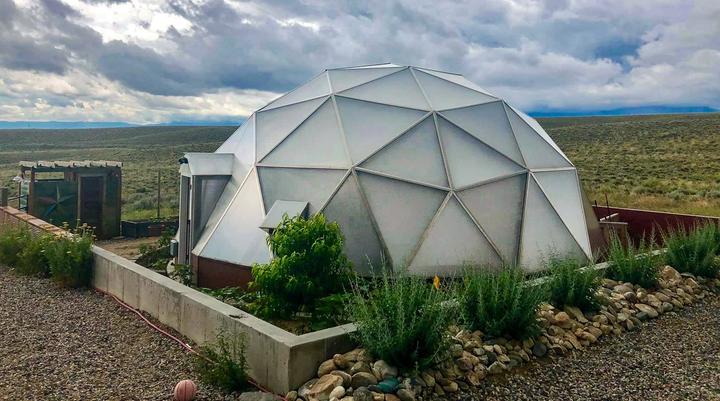
Hot dry climates (Phoenix, Las Vegas, Albuquerque; Southwest)
Mild winters mean year-round cool-season crops grow easily. Summer is brutal even with shade and ventilation; many growers limit summer to heat-tolerant crops (eggplant, peppers, okra, sweet potatoes) or treat peak summer as rest. Active warm-season fruiting through July in Phoenix requires evaporative cooling and is a reasonable hobbyist investment.
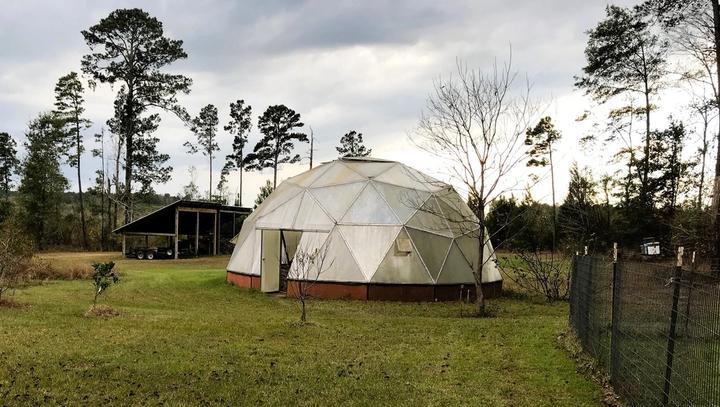
Hot humid climates (Houston, Miami, New Orleans; Southeast)
The natural growing seasons flip in your dome. Winter is your prime warm-season growing season; tomatoes, peppers, eggplant thrive November to April. Summer is for heat-and-humidity-tolerant tropicals (okra, sweet potatoes, southern peas) or for rest. Active summer warm-season fruiting (running tomatoes through July in Houston) requires substantial active equipment and is a demanding hobbyist goal that fights the climate rather than working with it.
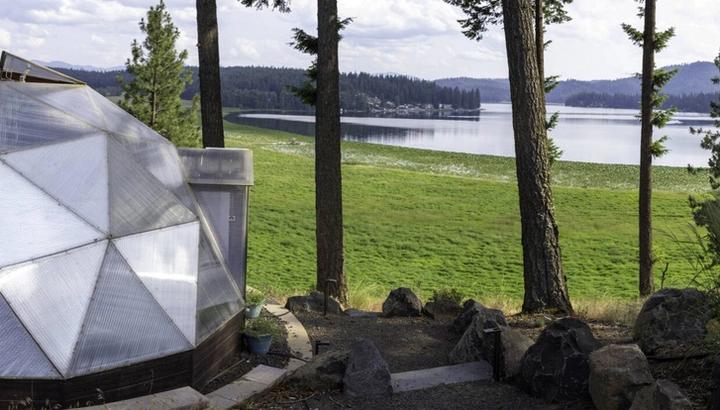
Mild climates (Pacific Northwest, Coastal California)
The most forgiving climate for the dome. Year-round growing without active equipment is straightforward. Cool-season crops thrive through winter with the dome's modest temperature uplift; warm-season crops in their natural season.
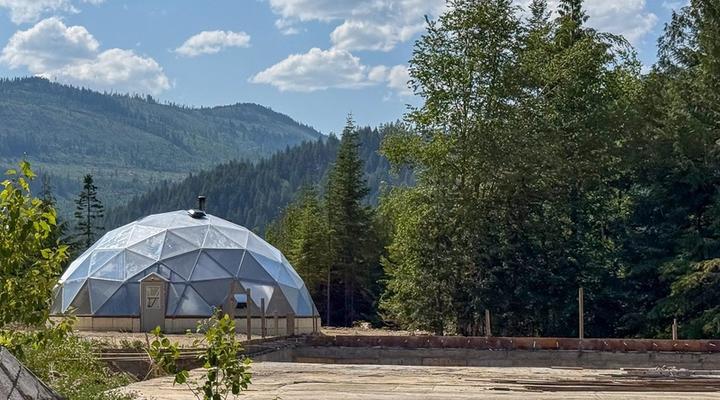
Cold mixed dry climates (Denver, Salt Lake, Mountain and inland West)
Active 3-season production is straightforward. Cool-season winter crops work with little or no active heat. Drift-accepted year-round warm-season plants survive winter with a small supplemental heater. Productive winter harvest of tomatoes and peppers at 50 °F maintain (case 4) requires the larger heat-pump-plus-supplemental sizing the calculator's Strict mode returns.

Cold mixed humid climates (Chicago, Minneapolis, Boston; Northeast and Midwest)
Similar to cold mixed dry zones for winter heating decisions, with humidity adding a consideration in summer. Active 3-season production works passively. Drift-accepted year-round warm-season survival uses a small supplemental heater. Productive winter harvest requires Strict-mode equipment plus a dehumidifier in summer. Active summer fruiting is more demanding than in dry climates.

Cold continental climates (high Rockies, Canadian border, interior Alaska)
The cold-continental zone covers a wide range of operating conditions. The high Rockies (Pagosa Springs, Steamboat, Telluride) operate notably milder than the upper Midwest and Plains (Bismarck, Duluth, International Falls), which in turn operate milder than interior Alaska (Fairbanks). Across this range the dome remains valuable for season extension and for drift-accepted year-round operation, with the equipment requirements scaling to your specific site rather than to a band average.
Where a Growing Dome may warrant help
The dome may not handle everything passively in specific scenarios. The calculator returns active equipment in three patterns, depending on climate and growing goal. Understanding which pattern applies to you helps the recommendation make sense.
Pattern 1: A small supplemental heater for cold cloudy nights
In cold-mixed and cold-continental climates running cases 1, 2, or 3 (3-season frost protection, year-round cool-season crops, or drift-accepted year-round warm-season plants), the dome's passive systems carry typical winter days. Solar gain warms the dome above ambient on clear days; pond mass stores that gain and releases it overnight; on cold cloudy nights, a small supplemental heater fills the gap that passive systems can't carry alone.
The calculator scales this recommendation to your specific site within the band, not to a band average. For example:
| Location | Climate zone | Supplemental heat |
|---|---|---|
| Pagosa Springs, CO | Cold-continental (high Rockies) | ~7 kBtu/h |
| Bismarck, ND | Cold-continental (Plains) | ~10 kBtu/h |
| Fairbanks, AK | Cold-continental (cold edge) | ~16 kBtu/h |
| Denver, CO / Chicago, IL | Cold-mixed | ~3 kBtu/h (smallest practical retail size) |
| Mild climates | Mild | None needed |
The methodology paper (section 9.4) documents the sizing formula. The relaxed-mode design temperature is derived from your January average low and July average high, a continentality-adjusted value that captures how cold your specific site actually gets, rather than treating all cold-zone sites the same. The pond's continuous thermal-mass contribution is included as a concurrent passive credit, since the pond is still contributing while the heater is running.
Direct heating of the pond (a small electric heater pointed at the pond, or an immersion heater for the pond water) is often more efficient than heating dome air, because it charges thermal mass that releases through the night.
Pattern 2: Active cooling for hot-summer warm-season fruiting
If you choose the active cooling option for summer, the calculator returns equipment based on your climate:
| Climate | Active summer cooling approach |
|---|---|
| Hot dry (HZ-HD) | Evaporative cooling plus a small heat pump for residual humidity |
| Hot humid (HZ-HH) | Heat pump with dehumidifier and thermal shade curtain |
| Cold-mixed humid (MZ-H) | Heat pump with dehumidifier |
| Cold-mixed dry (MZ-D) | Evaporative cooling plus a small heat pump |
For summer-passive operation (the calculator's default), none of this equipment shows up. Most growers don't run active summer cooling, even in hot climates, because the work-with-the-climate alternative (different plants in different seasons) is usually a better trade than overriding climate with equipment.
Pattern 3: Heat pump plus supplemental for productive winter harvest (case 4 strict)
If you want productive winter harvest of warm-season fruiting crops (tomatoes, peppers actively producing in January in cold-mixed or cold-continental climates), the dome can do this, and it's the most equipment-intensive operation the calculator covers. The Strict mode in the calculator returns the heat-pump capacity classes plus supplemental heat: the equipment sized to hold 50 °F continuously through the worst hours per year.
Section 6 covers this case in more detail. It's the right operation for a small but real customer audience: hobbyists or producers committed to winter tomatoes in Denver or commercial growers needing reliable productive bands. It's not what most Growing Spaces customers run.
Productive winter harvest (Pattern 4: Strict Mode)
A specific audience for this guide: growers who want productive winter harvest of warm-season crops at the 50 °F maintain target with no drift. This is pattern 4 in the methodology's tolerance spectrum, and the most demanding operation the calculator covers.
In the calculator, switch to Strict mode in advanced options. The recommendation changes from the pattern-1/2/3 small-heater output to the heat pump capacity classes plus supplemental heat sizing (section 9.4.7). This is the equipment that holds 50 °F band edges under ASHRAE 99 % design conditions with strict band compliance through the worst hours per year.
This is meaningfully more equipment than the patterns 1, 2, or 3 customer needs. A 26 ft in Pagosa running pattern 4 strict gets a 18 kBtu heat pump and 10 kBtu supplemental heater (28 kBtu·h⁻¹ total capacity). The same dome running pattern 2 relaxed gets a 6 kBtu single heater. The difference reflects that pattern 4 holds the band continuously through the worst hours per year against a band-representative cold extreme; patterns 1, 2, and 3 supplement passive systems on cold cloudy nights typical for your specific site, and accept drift between maintain and critical temperatures.

Special cases
15 ft and 18 ft domes. Small domes are best treated as passive-first across all climates and all operating goals. The combination of small interior volume and small heating load means typical 1-ton minisplit equipment is oversized and produces noticeable noise and turbulence near plants. In cold climates where you want winter freeze protection, add a quiet supplemental heater. For warm-climate summer use, a portable dual-hose air conditioner is often more practical than a permanent installation. The calculator flags this on small-dome recommendations.
Cold-continental sites at the cold edge of the band. The CZ band covers a wide range from the high Rockies (Pagosa, Crested Butte, ~-11 °F site-specific design) to interior Alaska (Fairbanks, beyond -40 °F). The calculator's site-specific sizing in Relaxed mode reflects these differences. For sites near the cold edge of the band (interior Alaska, far-northern continental sites with January average lows below -20 °F), additional considerations apply: pond charging from limited winter daylight is less effective, multi-day cloudy stretches are more common, and the §9.6 sizing assumptions may need site-specific verification. Strict mode in CZ uses the band-representative -15 °F regardless of site, which is intentional for that mode but doesn't capture the additional severity at the cold edge. The methodology paper §9.6.6 covers the assumptions that may not hold at extreme latitudes; partner verification is recommended for these sites regardless of which mode you target.
High-wind, high-altitude, or shaded sites. Wind-driven infiltration, reduced solar gain, and reduced atmospheric pressure all affect performance. The calculator doesn't model these explicitly. For sites with unusual exposure, request a project review from Growing Spaces.
Humidity in hot-humid and cold-mixed humid climates. Humidity is often the harder problem than temperature. The dome's passive cooling (shade, ventilation, pond) handles temperature but not vapor. If you're running active warm-season fruiting through summer in these zones, plan on a heat pump or dedicated dehumidification regardless of how the temperature side reads.
What if you do not install the pond?
This guide assumes the Growing Dome is built and operated as designed, including the above ground pond. The pond is not just a water feature. It is part of the thermal system.
Without the pond, the dome has less thermal buffering. Temperatures swing faster, heating and cooling equipment runs more often, and the calculator result may understate what you need. If you are not installing the pond, use the calculator result as a starting point and request project-specific review.

Talking to your HVAC contractor
If the calculator returns active equipment, the next step is usually a conversation with a local HVAC contractor.
Most contractors size for residential 70 °F maintain. A Growing Dome runs 35-50 °F maintain depending on operating goal, with a 90 °F summer maximum. Equipment sized for a house is typically 2-4x larger than a dome needs. This is the most common reason a contractor's quote differs from the calculator result.
For Relaxed-mode recommendations (the calculator's default), the equipment is usually a single supplemental heater rather than a full heat-pump install. Contractors are sometimes surprised by how small this equipment is. Two reasons the §9.6 Relaxed sizing produces smaller equipment than house-style HVAC sizing: the formula credits the dome's pond contribution explicitly as a continuous concurrent passive heat source, and the relaxed-mode design temperature is derived from your site's specific climate normals rather than from band-representative or worst-case ASHRAE 99 % values. The combined effect is equipment sized for cold cloudy nights with the pond running, not for steady-state worst-hour conditions.
For Strict-mode recommendations (productive winter harvest), the equipment is heat pump plus supplemental, sized per §9.3 and §9.4 of the methodology paper using band-representative ASHRAE 99 % design conditions.
What to share with your contractor
- Dome diameter, ZIP code, and elevation
- Operating goal: 3-season, 4-season cool, or 4-season fruiting; passive or active summer
- Tolerance: Relaxed (the default; drift accepted between maintain and critical temperatures, site-specific sizing) or Strict (productive band compliance, band-representative sizing, no drift)
- Whether the pond is installed and maintained
- The calculator result, including the recommended capacity and the design temperature shown in the disclosure
- Whether you plan to use evaporative cooling
What to ask your contractor to verify
- Rated heating capacity at your local winter design temperature, not at the AHRI 47 °F rating
- Low-ambient operation and defrost behavior
- Condensate drainage and freeze protection for the outdoor unit
- Whether the indoor head location creates uncomfortable air movement near plants
- Whether humidity control matters in your climate
- Local code, permitting, and utility considerations
What to question
- Sizing for 70 °F house-equivalent maintain: wrong target for a greenhouse
- Recommendations that ignore the dome's passive systems
- Recommendations that ignore the pond's continuous thermal-mass contribution (relevant for §9.6 Relaxed-mode sizing)
- Heat pumps oversized "for safety" that will short-cycle in shoulder seasons
- Heat pumps recommended for case 1, 2, or 3 operation in cold zones: the calculator's Relaxed mode produces a single small heater for those cases per §9.6, and a heat pump is rarely the right tool
For 15 ft and 18 ft domes specifically, ask about quiet supplemental heaters and small dehumidification options instead of full minisplit installations. Standard ductless minisplit indoor heads are designed for residential rooms of comparable interior volume but produce noticeable noise and turbulence in small dome envelopes.
Growing Dome Heating & Cooling FAQs

Bottom line
Your dome is the climate system. The standard kit handles most growing goals in most climates. A small supplemental heater handles cold cloudy nights in cold zones for typical year-round operation, sized to your specific site rather than to a band average. Active cooling and heat-pump-plus-supplemental sizing show up specifically for active summer fruiting and for productive winter harvest at strict band compliance.
Start with the Greenhouse Climate Calculator. Pick your dome size, climate, and growing goal. For most growers, the answer is "your dome handles this passively" or "your dome plus a small supplemental heater handles this." When the answer is more demanding, use this guide to plan the conversation with your contractor.Start passive-first. Choose your winter goal — summer is summer in all three. Use the calculator for your ZIP code and dome size. Read the summer and winter recommendations as two parts of the same package. Treat the table in this guide as an upper-bound reference for the most demanding case, not a final specification. Then ask your HVAC contractor to verify the actual model, delivered capacity, controls, and installation details for your site. If you’d like some in person help, contact our Dome Advisors.