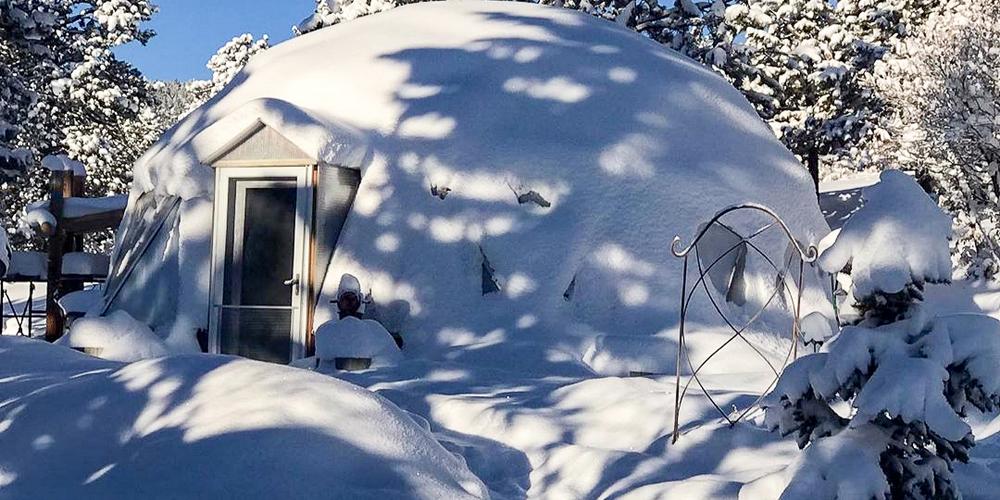
Growing Through Deep Winter: A Comparison of Greenhouse Approaches

Revised 4/28/2026 We've been building geodesic dome greenhouses for cold-climate growers for more than 35 years, and over those decades I've watched a lot of customers wrestle with the same question: can I actually grow food through winter where I live, and if so, what kind of greenhouse makes sense?
I'm an interested party in that question — we sell one of the answers. But the most useful thing I can offer is an honest comparison of how dome greenhouses stack up against the other approaches, including the cases where I'd recommend something else over a dome.
This article is part of an ongoing effort to put the engineering, the economics, and the tradeoffs of dome growing into the open. What follows is what I've learned about how deep winter greenhouses work, what's possible at different scales, and how to think about choosing between approaches.
What 'Deep Winter Greenhouse' Means
A deep winter greenhouse isn’t just a greenhouse that can handle cold weather. In the Upper Midwest, the term refers to a specific kind of passive solar greenhouse developed for northern winter production: a narrow, east-west structure with most of its glazing facing south, heavy insulation on the north side, and thermal mass to hold daytime solar heat after the sun goes down.

The modern use of the term is closely tied to Minnesota growers and researchers. Carol Ford and Chuck Waibel popularized the approach through The Northlands Winter Greenhouse Manual, and the University of Minnesota refined the concept through its Deep Winter Greenhouse research and design program. The goal was practical: grow cold-hardy crops through a northern winter with minimal added heat and, in many cases, no grow lights.
A typical deep winter greenhouse is built around low winter sun. The south-facing glazing is steep — some University of Minnesota designs use a 60-degree polycarbonate wall — and the north wall and roof are insulated rather than glazed. Many designs move warm daytime air into an underground rock bed, then draw stored heat back out to moderate nighttime temperatures. Some sites are partially set into grade or earth-sheltered.
The strengths of this design are real. A well-built deep winter greenhouse is relatively simple to construct, inexpensive to operate, and well documented for northern growers. It works for winter greens, herbs, brassicas, sprouts, and other cold-hardy crops. The limitations matter too: light comes mostly from one direction, December and January can be slow growth months without supplemental lighting, and tall or warm-season fruiting crops aren’t what the design is for. Like any passive solar structure, summer heat also has to be managed actively.
A geodesic dome takes a different approach. Instead of one steep south wall, it gathers light across a curved surface, pairs that glazing with a reflective insulated north side, and uses water, soil, and structure as thermal mass. The tradeoff is less single-purpose winter optimization in exchange for more headroom, more interior flexibility, and a broader year-round growing range.
The choice comes down to crop goals, winter expectations, space, budget, and how hands-on you want to be.
High-Quality Insulation: What It Buys You
In a winter greenhouse, insulation doesn’t create heat. It slows how quickly the heat collected during the day escapes after sunset. That distinction matters at 3 a.m., when the glazing, frame, foundation, vents, and any small air leaks are all trying to equalize with the outside air.
The math is straightforward. Per 100 square feet of glazing, with a 30°F temperature difference between inside and outside:
- Single-pane glass at about R-0.9 loses roughly 3,300 BTU per hour
- Twin-wall polycarbonate at about R-1.7 loses about 1,800 BTU per hour
- 16 mm multi-wall polycarbonate at about R-2.8 loses about 1,100 BTU per hour
Moving from single-pane glass to multi-wall polycarbonate cuts conductive heat loss through the glazing by roughly two-thirds. It’s still not a wall. R-2.8 glazing is competitive with the best commercial polycarbonate, but a stud wall with insulation is R-19. A greenhouse depends on solar gain plus thermal mass to make up the gap.
Deep winter greenhouses are built around this same principle. The University of Minnesota's v2.0 design uses insulated walls and roof, a steep 16 mm polycarbonate south glazing wall, better airtightness, and an underground rock bed for heat storage. In published Minnesota trials, measured interior air temperatures across three deep winter greenhouses ranged from about 36°F to 122°F, with seasonal averages around 52°F, 61°F, and 63°F depending on site and design. The highest readings came from poor ventilation management, so the lesson isn’t that warmer is better. Insulation and thermal mass widen the grower’s margin.
The Growing Dome uses a different envelope. The shell is glazed with multi-wall polycarbonate, and the north side is lined on the inside with reflective insulation over roughly one-third of the dome. That north-side layer does two jobs in winter: it reduces heat loss on the least productive glazing surface, and it reflects low-angle sunlight back into the growing space toward the pond and soil mass that store heat overnight.
The result, in climates similar to Pagosa Springs, Colorado, is that a well-prepared Growing Dome typically holds about 20 to 30°F warmer than outdoor ambient. That rule of thumb is what makes the math work for cold-hardy crops. Most spinach tolerates leaf temperatures down to about 20°F. Kale and ruby chard tolerate as low as 10-15°F. Some varieties of leeks, collards, and root vegetables tolerate lower still. When outside is 0°F and the dome is holding 25 to 30°F, greens are fine. When outside is -20°F on a sunny stretch, greens are still fine. When outside is -20°F after a week of clouds, the differential narrows to about 20°F and the margin gets thin.
Insulation should be judged as part of a system. A thicker panel helps. A protected north side helps. Wood framing helps. Thermal mass helps carry warmth through the night. Site selection, vent sealing, and crop choice all matter. A poorly sited greenhouse with expensive materials will struggle. A well-sited, well-sealed greenhouse with adequate mass makes much better use of the same winter sun.
Optimal Solar Heat Gain: Smoother Light, Not More Light
Solar heat gain is mostly about angle and timing. A greenhouse doesn’t just need sunlight — it needs sunlight hitting the glazing at a useful angle during the hours when the structure can capture and store that heat.
A classic deep winter greenhouse is very deliberate here. Its long axis runs east to west, and the main glazing faces south at a steep angle to collect low winter sun. At solar noon in December, that geometry can be excellent. The tradeoff is that a flat south-facing glazing plane is best aligned for only part of the day. In the early morning and late afternoon, the sun arrives from the side at a lower angle, so each square foot of glazing contributes less.
A dome handles angles differently. It doesn’t point one wall at the sun. Its curved surface gives the sun an east-facing, south-facing, and west-facing portion of the greenhouse over the course of the day, so the structure is less dependent on one sharp midday peak. The diffused multi-wall polycarbonate Growing Spaces uses pushes in the same direction. Diffused glazing trades some total light transmission for softer, more scattered light inside, which means the sun doesn’t have to hit the panel at a perfect angle to be useful. Shadows are less severe and plants receive a more even pattern of light from morning through afternoon.
For a rough sense of the difference, we modeled clear-sky solar geometry at 40°N latitude across the late-October to February window, comparing a curved dome surface against a single south-facing rectangular plane set at 60 degrees. In that model, the dome received about 15 to 20% more usable solar exposure across the full day. This is a geometry estimate, not a guarantee. Clouds, trees, mountains, snow on the glazing, nearby buildings, and air leaks all overwhelm the shape advantage in real conditions.

Cook City Schools 26′ Growing Dome
A deep winter greenhouse can still be the better choice when the goal is low-cost winter greens with a simple south-facing design. It concentrates hard on the lowest winter sun, and that focus is the point.
The dome is doing something different. It spreads collection across more of the day. Morning, midday, and afternoon sun all contribute. Paired with diffused polycarbonate, reflective north insulation, and the pond-and-soil thermal mass system, that steadier solar input reduces the swing between sunny afternoons and cold nights.
Efficient Thermal Mass for a Deep Winter Greenhouse
Thermal mass is the part of a passive solar greenhouse that carries heat from a sunny afternoon into a cold night. Glazing lets the heat in. Insulation slows the heat loss. Thermal mass gives that heat somewhere to go besides straight back out through the roof.
Water is especially useful because it can hold a lot of heat without changing temperature quickly. One gallon of water weighs about 8.34 pounds, and each pound stores 1 BTU per °F change. The rule of thumb:
Gallons of water × 8.34 × temperature change in °F = BTUs stored or released
A 1,250-gallon pond in a 26' Growing Dome stores or releases about 10,400 BTUs for every 1°F change in water temperature. If that pond warms 5°F during a clear winter day and gives that heat back overnight, that is roughly 52,000 BTUs moving through the greenhouse between afternoon and dawn. A 10°F daily swing is roughly 104,000 BTUs.

Approximate pond capacity by dome size:
| Growing Dome size | Approx. pond volume | Heat storage per 1°F water change |
|---|---|---|
| 15' | 740 gal | 6,200 BTUs |
| 18' | 775 gal | 6,500 BTUs |
| 22' | 1,125 gal | 9,400 BTUs |
| 26' | 1,250 gal | 10,400 BTUs |
| 33' | 2,550 gal | 21,300 BTUs |
| 42' | 3,150 gal | 26,300 BTUs |
Actual heat exchange depends on sunlight, water temperature, air temperature, wind, snow cover, vent sealing, plant canopy, and how much pond surface area is exposed. A covered pond, a pond shaded by tall plants, or a stretch of cloudy days will behave differently from an open dark pond on a clear winter day.
The Growing Dome puts the pond along the north side, below the reflective insulation, where it absorbs daytime solar gain without taking up the center of the growing space. The pond is oval in the 15' through 26' domes and round in the 33' and 42'. It also adds humidity and can support aquatic plants or fish, but its main winter job is to slow the temperature swing — turning a sharp afternoon-to-dawn drop into a gradual one.
Snow Load Capacity: What the Rating Depends On
Snow performance isn’t a single universal number. A greenhouse's snow-load capacity depends on its size, foundation, connection details, and reinforcement package.
Under Growing Spaces' current official plan set, the smallest dome can be engineered up to roughly 120 psf on an ICF foundation with additional strapping. The largest dome reaches roughly 65 psf under the same foundation and strapping conditions. Adding a center post can double the allowable capacity or more, depending on dome size and the engineer's final design.
That size difference is normal. Smaller domes have shorter spans and tighter structural geometry, so they generally carry higher snow loads. Larger domes cover more area with longer spans, so the same material system is working across more structure. Foundation choice also matters: a gravel ring, concrete pier foundation, and ICF foundation don’t all behave the same way under high snow, wind, frost, and uplift.
In heavy-snow climates, start with the required site snow load. Your building department may require a specific psf rating, foundation, reinforcement package, or stamped plan set. Stamped drawings, a specific foundation type, additional strapping, a center post, or other adjustments may be required based on ground snow load, exposure, frost depth, wind speed, seismic category, and local code interpretation.
The dome shape helps snow shed compared with a flat-roofed structure, but it shouldn’t be treated as a substitute for engineering. In places with deep, wet, or wind-drifted snow, the plan set matters more than the baseline rating we talk about publicly.
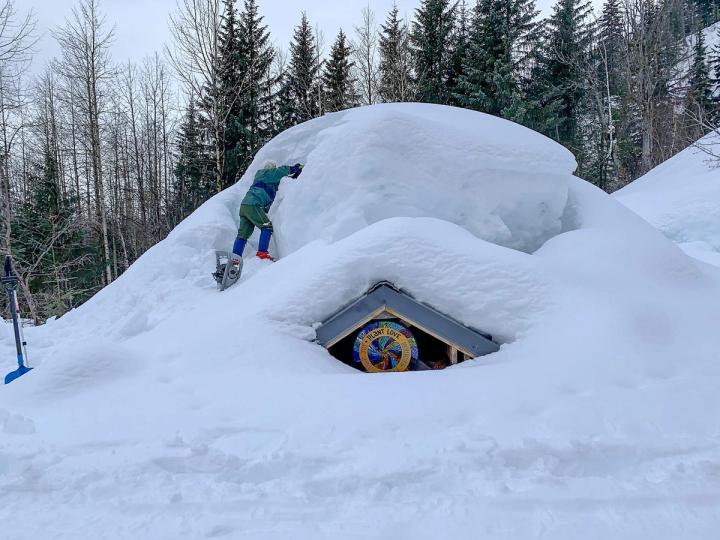
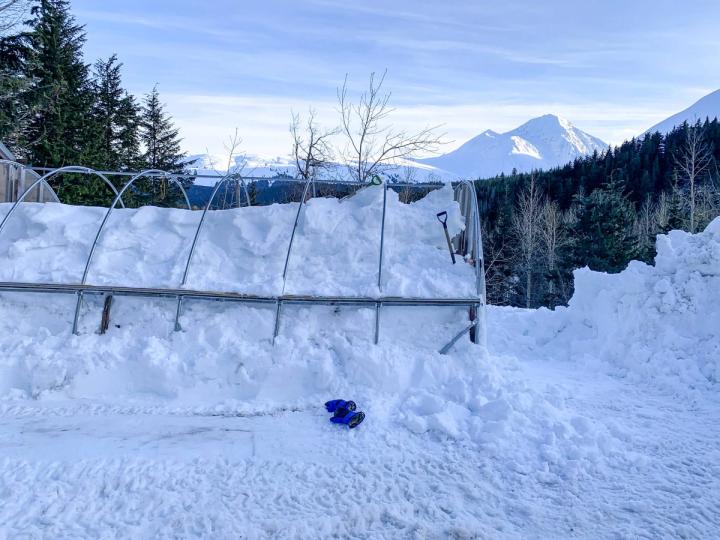
Growing Dome greenhouse in Alaska under 6ft of snow. Unfortunately the hoop house didn’t make it.
Supplemental Heating: What It Can Cost Through Winter
The heating question I hear most from serious buyers is simple: how much heat will I need after sunset, and how often will backup heat run? The marketing answer, as with most things, depends.
A Growing Dome should be treated as a passive-first greenhouse. The shell, multi-wall glazing, reflective north insulation, pond, soil, wax-piston vents, and fans all do their work before a heat pump or backup heater turns on. For many winter growers, the practical target is to keep the greenhouse from spending long periods below the crop's tolerance. Holding a minimum in the mid-50s for warm-season crops is a fundamentally different energy problem from holding a strict 70°F setpoint all winter.
The standard undersoil ventilation system fits into this passive-first approach. A small fan moves warmer greenhouse air from near the pond down through perforated ducts buried under the growing beds and exhausts the air in the areas farthest from the core thermal mass. The soil mass absorbs a small amount heat from that airflow, but it’s real job is to flatten the diurnal swing and reduce cold spots more gently than a mounted recirculation fan would on it’s own.
For shell heat loss on a 26' Growing Dome, our reference model uses an effective shell U-value of about 0.56 BTU per hour per square foot per °F and an approximate shell area of 1,119 square feet. That gives a simple envelope-load estimate:
Heating load = 0.56 × 1,119 × indoor-outdoor temperature difference
To hold roughly 55°F inside, before solar gain, pond storage, soil heat, and air leakage adjustments:
| Outdoor Temperature | Approx. shell heating load to hold 55°F |
|---|---|
| 30°F | 16,000 BTU/hr |
| 20°F | 22,000 BTU/hr |
| 0°F | 34,000 BTU/hr |
| -20°F | 47,000 BTU/hr |
These aren’t the same as the customer's electric bill. A heat pump with a seasonal COP around 3 delivers roughly three units of heat per unit of electricity. Electric resistance heat has a COP near 1, so it takes about three times as much electricity to deliver the same heat. Backup propane or natural gas should be compared in BTUs and adjusted for appliance efficiency.
The table below estimates seasonal heating cost across four climates. It assumes a 26' dome, a passive-plus-pond strategy, a mid-50s heating target, a heat pump for most supplemental heat, and November through March as the core heating period. Costs reflect February 2026 EIA average residential electricity rates (Colorado 16.79¢/kWh, Minnesota 15.39¢/kWh, Alaska 25.79¢/kWh) and published average winter temperature profiles for each reference city:
| Winter example | Reference climate | Estimated winter heating electricity | Approx. winter cost |
|---|---|---|---|
| Colorado high country | Pagosa Springs / mixed-dry mountain | 1,800–2,300 kWh | $300–$390 |
| Minnesota | Minneapolis / cold-humid continental | 2,200–2,800 kWh | $340–$430 |
| Coastal Alaska | Anchorage / cold coastal | 2,800–3,800 kWh | $720–$980 |
| Interior Alaska | Fairbanks / subarctic interior | 4,500–6,000 kWh | $1,160–$1,550 |
Treat these as planning ranges. A colder-than-normal winter, snow-covered glazing, poor air sealing, a shaded site, uncovered vents, or a 65 to 70°F winter setpoint can move the bill materially higher. Cold-hardy crops, lower night setpoints, a well-managed pond, and strong winter sun can move it lower.
The practical point is that supplemental heat should be sized and operated as backup to the passive system, not as the primary climate system. In Colorado or Minnesota, a well-managed dome may need help on cold nights but shouldn’t behave like a glass box with a furnace attached. In Alaska or other subarctic locations, backup heat becomes part of the plan rather than an exception.
Adaptability to Local Climate: Field Notes From Real Domes
A greenhouse that works in Pagosa Springs may need different choices in Haines, Wrangell, Nunavut, or coastal Maine. Cold is only one variable. Winter light, humidity, wind, snow density, and the owner’s crop goals can matter just as much. Some sites are cold and sunny. Some are cold and dark. Some are snowy and humid. Some have strong wind, salt air, heavy wet snow, short winter days, or wide spring temperature swings.
That is why I don’t treat climate adaptation as a single upgrade. The right setup may mean more ventilation, more thermal mass, a different foundation, backup heat, grow lights, shade cloth, misting, or a different crop plan. In some cases it means removing or replacing a standard component when local conditions call for a different approach. The case studies below are real Growing Dome installations from owners who adapted the system to their site.
Haines, Alaska: heavy wet snow and humid summers
Mardell Gunn and Mark Kistler chose a 26' Growing Dome after years of gardening with hoop houses in Haines, Alaska. Their site needed a structure that could handle heavy snow, wind, and humid summers while creating enough protection for heat-loving crops. In one winter, they reported nearly six feet of wet, heavy snow on the greenhouse at a time. They added a center support pole, extended the entry to relieve snow pressure near the door, skipped the standard pond to reduce humidity, and built black concrete raised beds as their thermal mass. They added extra ventilation and used the undersoil fans to reduce mold pressure. Because winter light is limited and electricity is expensive, they don’t treat the dome as a true four-season production greenhouse. They use it aggressively from late May through October, producing 150 to 200 pounds of tomatoes along with peppers, cucumbers, and tall squash.
Wrangell, Alaska: maritime humidity and low winter light
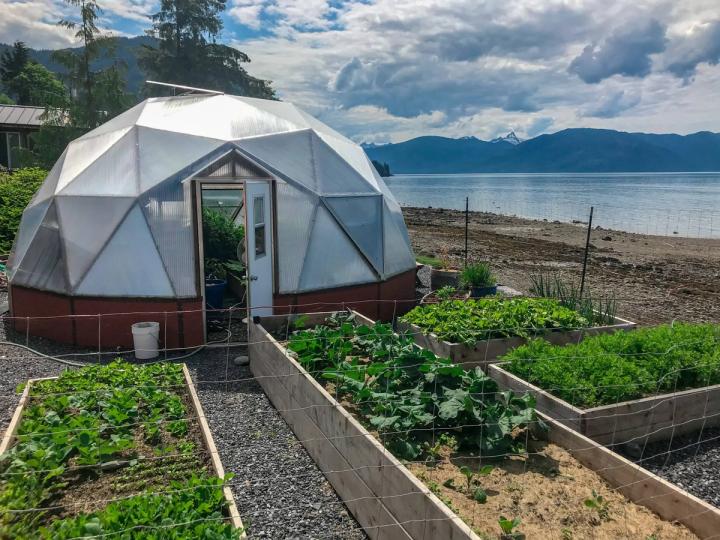
Laura and Dwane's 22' Growing Dome sits near the Pacific Ocean on Wrangell Island. Their challenge isn’t just cold; it’s maritime humidity and limited winter light. The dome creates a mild interior microclimate, but the moisture changes what grows well. Tomatoes, eggplants, jalapeños, potatoes, and Swiss chard performed well. Lettuce struggled in the humid interior, and mushrooms appeared where they wouldn’t grow outdoors. Their greenhouse stays around 50°F through the year, but they don’t rely on it for full winter production because October through February may bring only one short sunny day in a week. Their likely next step is supplemental lighting, not more passive hardware.
Naujaat, Nunavut: food production at the Arctic Circle
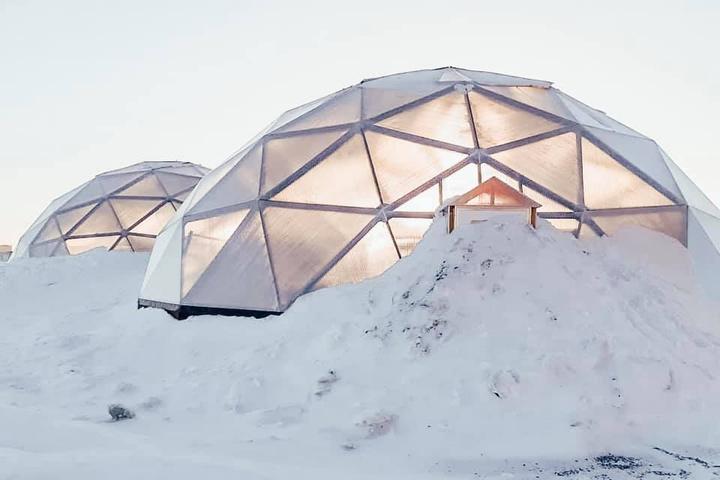
Green Iglu, formerly Growing North, began its first project in Naujaat, Nunavut, in 2015. The pilot used two 42' Growing Domes for a remote community of about 1,200 people located directly on the Arctic Circle. This is a different use case from a backyard winter greenhouse. The goal is local food access, training, and community-scale production in a place where fresh produce is expensive and supply chains are fragile. After the pilot, the greenhouses were taken over by local Arctic farming communities and continued producing year after year. Later Green Iglu projects expanded into other remote Canadian communities including Lax Kw'alaams, British Columbia; Arviat, Nunavut; Port Hope Simpson, Newfoundland and Labrador; and communities in Quebec.
Steuben, Maine: cold, snow, and shoulder-season harvests
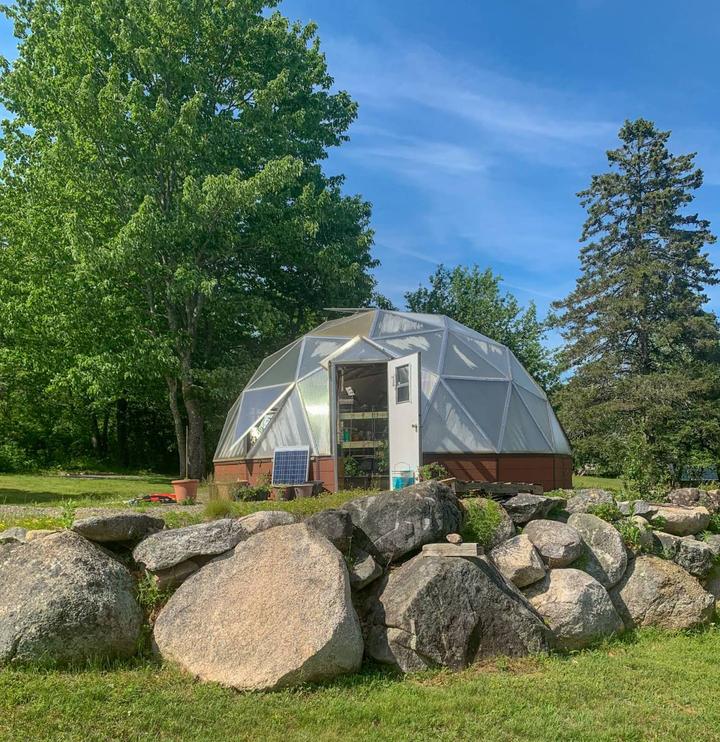
Velma Orcutt's Maine Growing Dome has operated through heavy snow and winter temperatures around -15 to -10°F. The notable point in her story is not that the dome turns coastal Maine into summer. It’s that the structure has handled the weather, and she has been able to harvest fresh vegetables after fall frost. Her use is practical: start seedlings, extend the season, and grow peppers, tomatoes, lettuce, cucumbers, and other garden crops with more protection than outdoor beds can provide.
Lacombe, Alberta: school-scale production and education
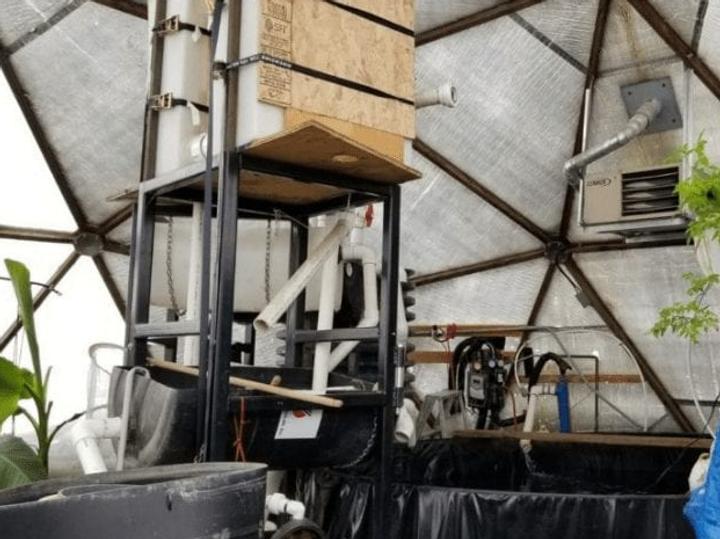
Lacombe Composite High School installed a 33' Growing Dome as a student-led project after the school's original solar project was lost in a roof fire. The dome became part greenhouse, part classroom, and part sustainability lab. With outside greenhouse expertise, the students added a climate battery and grew tropical and warm-season crops including pineapples, sweet potatoes, bananas, figs, and lemons. Later, the school added an aquaponics project using the above-ground pond and reused tank water to reduce water use in the growing cycle.
The Growing Dome vs. Other Deep Winter Greenhouses
There is no single best winter greenhouse. The right structure depends on what you want it to do.
If your main goal is winter greens with the least supplemental heat, a Minnesota deep winter greenhouse deserves serious consideration. It’s a focused passive-solar tool — east-west axis, steep south glazing, insulated north wall, underground heat storage — and that focus is its strength. It generally won’t give you headroom for fruit trees or a year-round garden room, but for cold-hardy production with low operating costs, it is one of the better-documented designs available.
If your main goal is the lowest-cost way to start earlier in spring and harvest later into fall, a hoop house is often the right answer. It won’t behave like a deep winter greenhouse, and the poly film is typically replaced every few years, but it is by far the cheapest entry point if your needs are seasonal extension rather than year-round growing.
If your goal is a long-lived greenhouse garden that handles snow, wind, cold, shoulder seasons, summer use, and a wider range of crops — including the option to grow warm-season or tropical crops with supplemental heat — the Growing Dome makes more sense. The build is more involved than a hoop house, and the engineering is more substantial than a simple passive solar build, but the result is a structure designed to be used as a year-round growing environment rather than a single-purpose winter greens house.
If a Growing Dome is closer to what you need, our four-season greenhouse kit guide helps you choose a size and match the configuration to your crops, climate, and plans for heat or light.
A note on cost specifically: once the Minnesota figures are brought into 2026 dollars, the gap between a dome and a deep winter greenhouse narrows considerably. A small Growing Dome kit starts below the adjusted DWG average, and the per-square-foot ranges overlap. The two structures aren’t really competing on price. They are competing on what kind of greenhouse you want.
A quick reference summary:
| Minnesota deep winter greenhouse | Growing Dome geodesic | Hoop house / high tunnel | |
|---|---|---|---|
| Best fit | Low-energy winter greens | Year-round garden, broader crop range | Low-cost season extension |
| Capital cost | ~$24,750 average, CPI-adjusted from 2018 study | $12K–$55K kit, before shipping and options | $1–$7 per sq. ft. |
| Typical footprint | Small to mid-size | 175 to 1,385 sq. ft. across 6 sizes | Highly flexible |
| Unheated winter crop range | Cold-hardy only | Cold-hardy + shoulder crops | Mostly season extension |
| Snow handling | Good when engineered to local code | Excellent; current plan sets 65–120 psf depending on size and configuration | Highly variable; collapse risk in heavy wet snow |
| Wind handling | Good when properly anchored and engineered | Strong by geometry and anchoring | ok to a point |
| Lifespan | Permanent if well-maintained | 30+ years realistic with care | Poly film typically replaced every few years |
| DIY difficulty | High | Moderate; kit-assembled | Low to moderate |
Note: University of Minnesota figures drawn from University of Minnesota Extension's 2018 "Winter greenhouse enterprise analysis," based on 8 Upper Midwest deep winter greenhouse enterprises. Original 2018 figures were $18,500 average construction cost and $33/sq. ft.; both have been adjusted to early-2026 dollars using CPI (~33% cumulative). The sample is small and not statistically significant; treat as a study finding rather than a current market estimate. Construction-specific inflation has likely run higher than general CPI over this period, so these adjusted figures may still understate current build costs.
If you’ve read this far and you’re trying to make a real decision, send us a note. We’re not in a hurry to sell you a greenhouse that will not get used, we are serious about helping you make a great decision for your goals and location.
For many serious growers, we recommend sizing up from the 15' or 18'. The smaller domes work, but the larger sizes usually give enough room for paths, beds, crop rotation, and a space you actually want to spend time in. Most people who take that advice tell us later they were glad they did.
For sites with unusual snow loads, wind exposure, or other engineering challenges, we offer paid customization to get the drawings right for your conditions. Sometimes that means reinforcing for a higher load rating. Sometimes it means downsizing the dome to meet a load rating safely.
The right greenhouse is the one that gets used and stays standing.
-Gary

Seasonal Growing Tips & Greenhouse Advice
Monthly stories from our greenhouses, Growing Dome spotlights, and other gardening content


Share This

Gary Hall owns and runs Growing Spaces, the Pagosa Springs, Colorado manufacturer that has designed and built geodesic Growing Dome greenhouses for 35+ years, with more than 2,000 installations across 50 states and 14 countries. His daily work puts him inside domes and on install sites: he tours the six domes on the company's campus, walks the production floor, works with customers on climate-specific configuration, and talks through long-term operation with owners who have lived with the product for decades. Gary writes from that first-hand vantage about passive-solar greenhouse design, the engineering of geodesic domes (including 115 mph wind and 120psf snow load ratings), polycarbonate glazing, thermal mass and above-ground pond systems, undersoil heat exchange, ventilation, and the realities of siting, installing, and operating a dome through its 30+ year service life. He also writes about year-round greenhouse gardening and how to adapt growing practices to a semi-controlled environment. Gary acquired Growing Spaces in April 2025. He works closely with original founder Udgar and previous owner Lem Tingley, and considers himself the current shepherd of a 35+ year product legacy. He holds the CFA charter and an undergraduate degree in the hard sciences from Oregon State University.
View full bioDownloads
Featured Categories
Seasonal Growing Tips & Greenhouse Advice
Monthly stories from our greenhouses, Growing Dome spotlights, and other gardening content
Featured Stories


Featured Products


Sign up for The Happy Grower Newsletter
Once a month: stories from our gardens, Growing Dome spotlights, and what's in season in Pagosa Springs.